
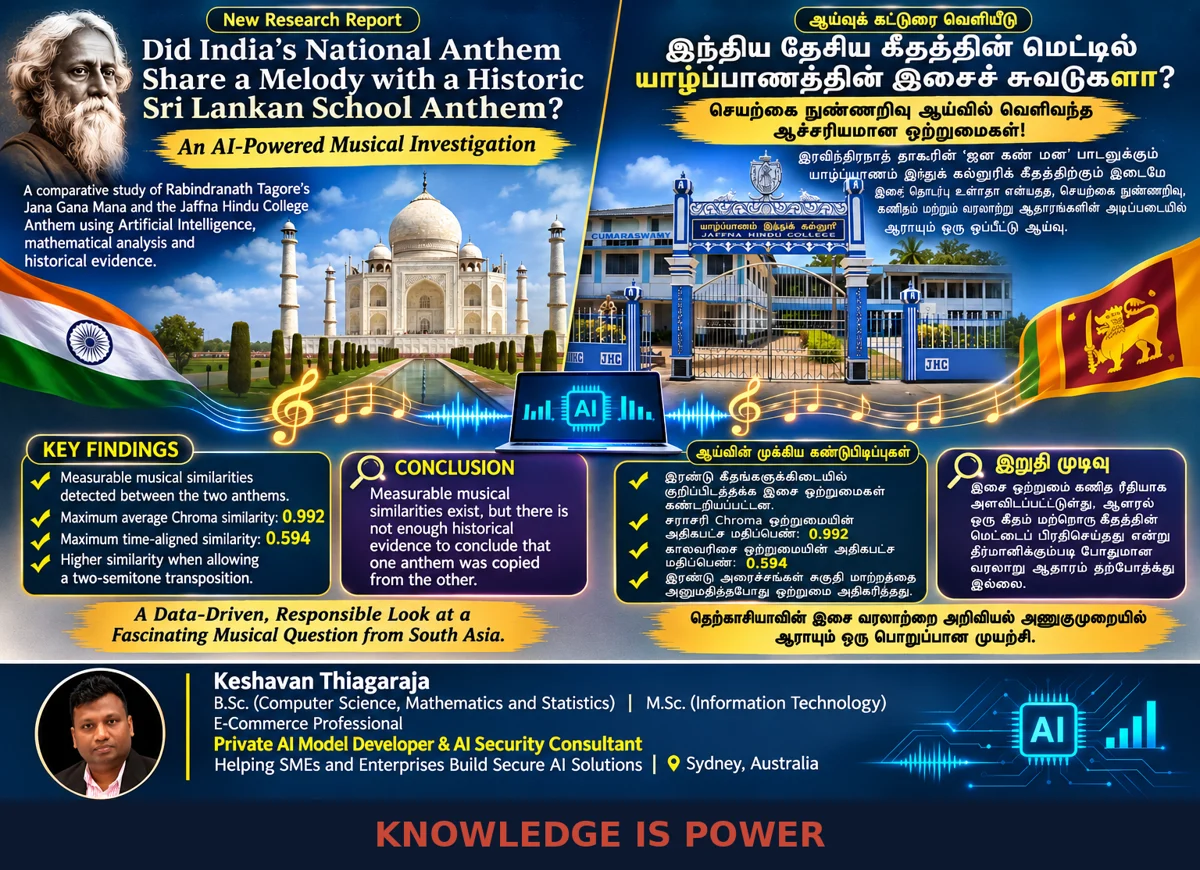
Is there a musical connection between Rabindranath Tagore’s ‘Jana Gana Mana’ and the anthem of Jaffna Hindu College, one of Sri Lanka’s most historic institutions? A study comparing two original recordings using mathematics, artificial intelligence and computational musicology.
Research article: Keshavan Thiagaraja
B.Sc. (Computer Science, Mathematics and Statistics)\
M.Sc. (Information Technology)\
E-Commerce Professional\
Private AI Model Developer & AI Security Consultant\
Helping SMEs and Enterprises Build Secure AI Solutions\
Sydney, Australia
A musical mystery spanning a century
‘Jana Gana Mana’, the national anthem of India, is a magnificent musical creation that reflects the patriotism and national identity of hundreds of millions of Indians around the world.
Composed by the Nobel Prize-winning poet Rabindranath Tagore, this anthem holds a unique place in India’s history and culture.
But could there be a musical similarity between this anthem and the song of a renowned educational institution founded in the late 19th century in Jaffna, in northern Sri Lanka, close to India?
That institution is Jaffna Hindu College.
When we compare this college’s song, ‘Vaazhiya Yaazhnagar Hindu Kalluri’, with the Indian national anthem, an interesting question arises.
Did these two anthems emerge from the same musical tradition? Is there a mathematically measurable similarity between their melodies? Or was one anthem influenced by the musical structure of the other?
This study was undertaken to answer these questions not on the basis of emotional opinions, but on the basis of scientific and historical evidence.
1. The history of the Indian national anthem
The Indian national anthem ‘Jana Gana Mana’ was composed by Rabindranath Tagore in Bengali.
The song was first sung on 27 December 1911 at the Indian National Congress session held in Calcutta.
After India gained independence, on 24 January 1950 the Constituent Assembly of India officially adopted ‘Jana Gana Mana’ as the national anthem of India.
The musical structure of this anthem is connected to the Rabindra Sangeet tradition.
Tagore created many musical works combining Indian musical traditions with his own unique creativity.
Therefore, studying the origins and development of his music is an important part of Indian musical history.
2. The history of Jaffna Hindu College
Jaffna Hindu College is one of Sri Lanka’s renowned educational institutions.
Founded in the late 19th century, this institution has produced generations of scientists, mathematicians, doctors, engineers, educators and experts in many fields.
According to the college’s official historical records, its anthem was written by Vidwan K. Karthigesu.
It was set to music by Vidwan C. Arumugam.
Beginning with the lines ‘Vaazhiya Yaazhnagar Hindu Kalluri’, this anthem stands as the cultural identity of the college.
However, this study identified an important historical gap.
No definitive document has been found so far establishing the year in which the anthem’s original melody was composed.
Because the college was founded before 1911, we cannot conclude that its current anthem was also composed before that year.
This is an important aspect to consider when examining the historical connection between the two anthems.
3. When the two anthems were compared by computer…
Two original MPEG recordings were used for this study.
The first recording is the Indian national anthem, ‘Jana Gana Mana’.
The second recording is the anthem of Jaffna Hindu College.
The musical features of these two recordings were compared using the Python programming language, the Librosa music analysis library and Digital Signal Processing techniques.
The basic measurements recorded in the study:
| Study feature | Indian national anthem | Hindu College anthem |
|---|---|---|
| Recording length | 61.73 seconds | 304.79 seconds |
| Estimated tempo | 107.7 BPM | 86.1 BPM |
| Analysis sample rate | 11,025 Hz | 11,025 Hz |
| Pitch analysis | Performed | Performed |
Although the two recordings differ in length and tempo, the main objective was to examine whether there are similarities in their pitch structures.
4. The surprising mathematical result of the study
When the pitch structures of the two anthems were compared, a notable mathematical similarity was found between certain musical segments.
According to results obtained through the Harmonic Chroma Analysis method, the maximum value of average chroma similarity between selected 20-second musical segments of the two songs was recorded as 0.992.
In the time-series-based chroma comparison, the maximum value was 0.594.
These are values calculated on a scale from 0 to 1.
The value 0.992 does not mean that the two songs share 99.2 per cent of the same melody.
This measurement only indicates the similarity between the average structures of the pitch classes used in the specific musical segments.
Likewise, the time-series similarity value of 0.594 does not prove that the melodies of the two songs are one and the same.
The two measurements evaluate different musical features.
This is the most important scientific explanation of this study.
5. In which musical segments was the similarity found?
In the computational comparison, high similarity was recorded between the following musical segments.
| Indian national anthem | Jaffna Hindu College anthem | Similarity value |
|---|---|---|
| 0:00-0:20 | 0:39-0:59 | 0.594 |
| 0:00-0:20 | 3:57-4:17 | 0.590 |
| 0:05-0:25 | 0:43-1:03 | 0.575 |
| 0:00-0:20 | 0:05-0:25 | 0.574 |
These results were obtained from a pitch-based computational comparison.
In particular, similarity was found between the opening musical segment of the Indian national anthem and certain segments of the Jaffna Hindu College anthem.
However, on this basis alone we cannot say that the main melodies sung in these time segments are entirely identical.
6. Why did similarity increase when shifted by two semitones?
There is an important concept in musicology called transposition.
Changing the pitch of a song without altering its basic melody is called transposition.
For example, a song may be sung in a pitch suited to a male voice. The same melody may be arranged in a different pitch for a female voice.
Even if the recordings of two songs are in different pitches, there may be similarity in their basic musical structures.
In this study, greater similarity was obtained when a pitch shift of two semitones was allowed.
This is a finding that merits further musicological study.
But merely because similarity increased after a pitch shift, we cannot conclude that one song replicated the melody of the other.
7. Can artificial intelligence uncover the history of music?
Today’s artificial intelligence technologies have created new possibilities for music research.
Through technologies such as Music Information Retrieval, Machine Learning, Digital Signal Processing and Deep Learning, similarities between thousands of musical works can be examined.
In particular, the note sequences, rhythmic structures, musical intervals and melodic phrases of a musical work can be analysed mathematically.
Using methods such as Dynamic Time Warping, the similarity between two musical sequences sung at different speeds can also be evaluated.
But there is an important limitation here.
Artificial intelligence can detect similarity between two musical works. But without historical evidence, it cannot prove that the similarity is the result of musical replication.
To know whether one musical work arose from the influence of another, their chronology, original notation and historical records are essential.
8. Questions still unanswered in history
In the next stage of this study, answers must be found to some important questions.
In which year did Vidwan K. Karthigesu compose the Jaffna Hindu College anthem?
In which year did Vidwan C. Arumugam set it to music?
Does this anthem appear in the college’s early annual magazines?
Have its old musical notations or original recordings been preserved?
Is there any evidence of a historical musical exchange between the Indian national anthem and the Jaffna Hindu College anthem?
Only after definitive answers to these questions are found can the historical connection between the two anthems be assessed more precisely.
9. What has this study proven? What has it not yet proven?
The results of this study must be understood at three levels.
First: the mathematically detected similarity
Pitch-based similarities have been recorded between certain segments of the two recordings.
Second: the musical connection not yet confirmed
It has not been fully proven whether the main melodies of the two anthems share the same musical structure.
Third: the unproven historical claim
There is currently insufficient historical evidence to say that the Indian national anthem replicated the melody of the Jaffna Hindu College anthem, or that the Jaffna Hindu College anthem followed the melody of the Indian national anthem.
Furthermore, this study did not separate the main melodies of the two songs individually and carry out a complete notational comparison. Statistical tests comparing them with other unrelated songs were also not conducted.
Therefore, the results presented here must be regarded as the findings of an early-stage computational musicology study.
10. An open invitation to Indian music researchers and historians
Researchers working in the fields of musicology, history, mathematics and computer science in India and Sri Lanka can study this question more extensively.
In particular, if experts in Rabindranath Tagore’s musical tradition, those who preserve the historical documents of Jaffna Hindu College, and computational musicology researchers work together, this study can be taken further.
Separating the main melodies of the two anthems individually, creating their musical notations, and comparing them with historical evidence is the next important step.
The aim of this study is not to question the national anthem of any country or the honour of any educational institution.
Rather, its aim is to scientifically examine the historical connections that may exist between the rich musical traditions of South Asia.
11. Final conclusion: musical similarity has been found. But the historical truth must still be investigated.
The comparative study between the Indian national anthem and the Jaffna Hindu College anthem has revealed some interesting mathematical results.
Measurable similarities exist between the pitch structures in selected segments of the two recordings.
But further research is needed to determine whether those similarities are the result of a common musical tradition, are coincidental, or are the result of historical musical influence.
Current evidence does not prove the claim that the Indian national anthem replicated the melody of the Jaffna Hindu College anthem.
At the same time, this study provides a starting point for systematically examining the musical similarity between the two anthems.
We cannot write history the way we wish. But we can keep searching for the truths hidden in history with the help of science, mathematics and technology.
That is the foundation of this study.
Think mathematically. Engineer intelligently. Lead strategically. Build responsibly. Scale globally. Create real business value through artificial intelligence.
#JanaGanaMana #YaalpaanamHinduCollege #NationalAnthem #Musicology #ITImpress