
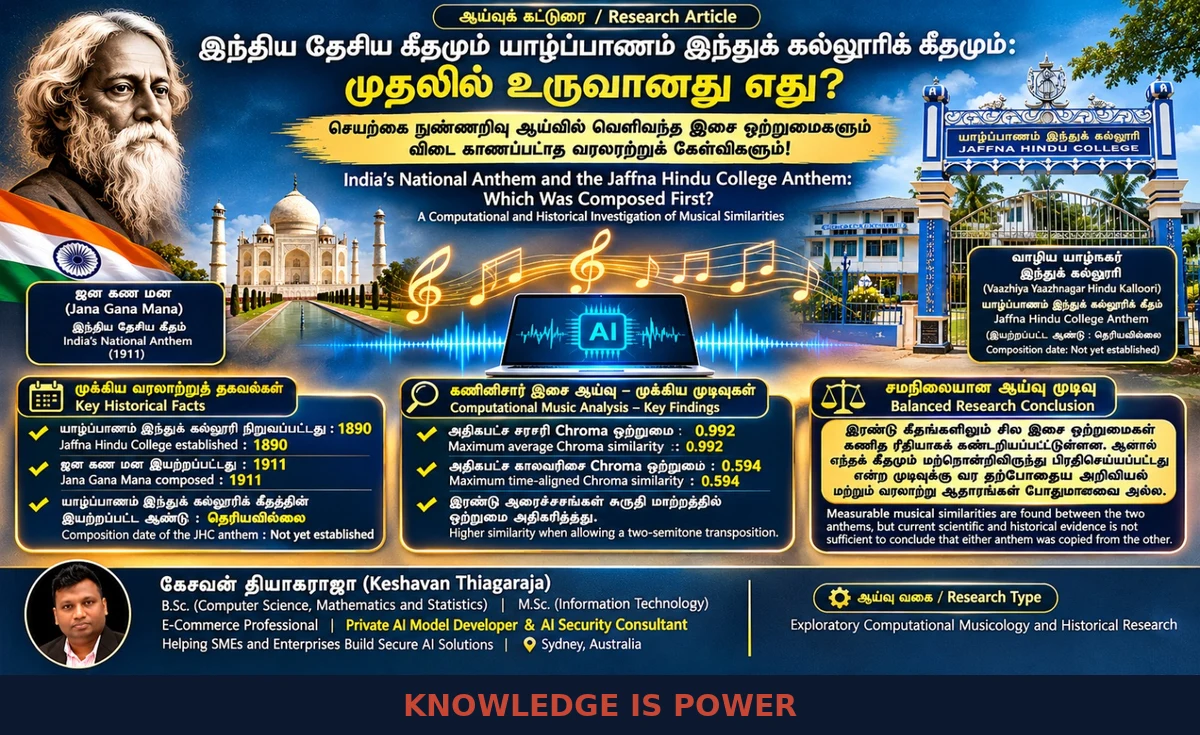
E get any music connection between di anthem of Jaffna Hindu College wey dem establish for 1890 and Rabindranath Tagore im ‘Jana Gana Mana’ wey e compose for 1911? Na exploratory study wey compare two recordings based on mathematics, computational musicology and historical sources.
Research article: Keshavan Thiagaraja
B.Sc. (Computer Science, Mathematics and Statistics)
M.Sc. (Information Technology)
E-Commerce Professional
Private AI Model Developer & AI Security Consultant
Helping SMEs and Enterprises Build Secure AI Solutions
Sydney, Australia
Research date: 3 November 2026
Research summary (Abstract)
Di main aim of dis study na to investigate whether any music similarity dey between India national anthem ‘Jana Gana Mana’ and ‘Vaazhiya Yaazhnagar Hindu Kalloori’, di anthem of Jaffna Hindu College, one of di most historical institutions for Sri Lanka.
For dis study, dem compare di recordings of di two anthems through computational musicology methods. Technologies like Python, Librosa, Digital Signal Processing and Chroma-based Similarity Analysis na wetin dem use.
For di computational comparison analysis wey dem don do before, di maximum average chroma similarity score between selected music segments na 0.992, and di maximum time-aligned chroma similarity score na 0.594.
Dis values show say mathematical similarities dey for some music features of di two anthems. But dem no prove say di main melodies of di two anthems be di same, and dem no prove say one anthem copy from di other.
Historically, dem establish Jaffna Hindu College for 1890. India national anthem ‘Jana Gana Mana’ na 1911 dem compose am and dem first sing am on 27 December of di same year.
But dem never still find any clear historical document wey fix di year wey dem first write and compose di anthem of Jaffna Hindu College.
So, based on di evidence wey dey available now, e no dey possible to finally decide which of di two anthems come first or whether music influence dey between dem.
Dis study present scientifically di music similarities between di two anthems and di unanswered questions about dia historical order.
1. Introduction: One historical question wey span one century
‘Jana Gana Mana’, di national anthem of India, na one music creation wey reflect di national identity and cultural pride of Indian people all over di world.
Dis anthem wey Nobel laureate Rabindranath Tagore compose get unique place for India history.
Jaffna Hindu College, wey dem establish for 1890 for Jaffna for northern Sri Lanka near India, sef get long education and cultural history.
When you compare di music structures of di college anthem ‘Vaazhiya Yaazhnagar Hindu Kalloori’ and India national anthem ‘Jana Gana Mana’, one interesting research question go come out.
Music similarity dey between di two anthems? If yes, na result of common music tradition, na accidental similarity, or na one music creation come out from di influence of di other?
Two separate investigations dey necessary to answer dis question.
First, to evaluate di similarity between di melodies of di two anthems with scientific and mathematical methods.
Second, to determine di years wey dem first write and compose di two anthems, based on reliable historical documents.
Even though di two investigations support each other, dem dey answer different questions.
2. Di history of India national anthem
India national anthem ‘Jana Gana Mana’ na Rabindranath Tagore write am for Bengali language.
Dem first sing dis song on 27 December 1911 for di Indian National Congress meeting for Calcutta.
After India independence, di Constituent Assembly of India officially adopt ‘Jana Gana Mana’ as di national anthem of India on 24 January 1950.
Tagore no be only poet, e be composer wey create im own music tradition too.
People dey call im music works ‘Rabindra Sangeet’.
Im creations come out against di background of Indian music traditions, Bengali culture and different music influences.
But dem never find any reliable document wey show direct historical connection between di music structure of ‘Jana Gana Mana’ and di anthem of Jaffna Hindu College.
3. Di history of Jaffna Hindu College
Jaffna Hindu College wey dem establish for 1890 na one of di most historical educational institutions for Sri Lanka.
Over many generations, dis college don produce scientists, mathematicians, doctors, engineers, educators and experts for different fields.
According to di official information of di college, na Vidwan K. Karthigesu write im anthem.
Na Vidwan S. Arumugam compose di music.
Dis anthem wey start with di lines ‘Vaazhiya Yaazhnagar Hindu Kalloori’ remain as di cultural identity of di college.
But one important historical question dey here.
Since dem establish di college for 1890, fit we say say im present anthem sef na 1890 dem create am?
No.
Di establishment year of one educational institution and di year wey dem write im anthem no suppose be di same by force.
Dem fit write im anthem many years after dem establish di college.
So, di establishment year of Jaffna Hindu College alone no fit serve as proof of di age of im anthem.
4. Which anthem dem create first?
Na dis be di most important historical question of dis study.
| Historical fact | Year | Evidence status |
|---|---|---|
| Jaffna Hindu College established | 1890 | Historical evidence dey |
| India national anthem ‘Jana Gana Mana’ composed | 1911 | Confirmed |
| ‘Jana Gana Mana’ first sung | 27 December 1911 | Confirmed |
| Jaffna Hindu College anthem written | Never find | More evidence needed |
| Original melody of Jaffna Hindu College anthem created | Never find | More evidence needed |
Dis table reveal one important truth.
Even though dem establish Jaffna Hindu College 21 years before dem compose India national anthem, person no fit conclude from dat one say im anthem sef dem create am before.
Also, di year wey dem write di lyrics and di year wey dem create di melody fit dey different.
So, to determine di real order of di two anthems, dia original composition dates dey necessary.
Until dem fill dis historical gap, person no fit say with certainty which anthem melody come first.
5. When dem compare di recordings of di two anthems by computer
For dis study, dem use two MPEG recordings.
First, India national anthem ‘Jana Gana Mana’.
Second, ‘Vaazhiya Yaazhnagar Hindu Kalloori’ of Jaffna Hindu College.
Dem analyse di two recordings with Digital Signal Processing methods based on Python and Librosa.
Di basic measurements wey dem record for di study be like dis:
| Study feature | India national anthem | Hindu College anthem |
|---|---|---|
| Recording length | 61.73 seconds | 304.79 seconds |
| Estimated tempo | 107.7 BPM | 86.1 BPM |
| Analysis sampling rate | 11,025 Hz | 11,025 Hz |
| Chroma music feature analysis | Done | Done |
Di length and tempo of di two recordings dey different.
But dis differences no prove say dia underlying melodies completely dey different.
Because person fit sing di same melody for different speeds, keys and instrument arrangements.
6. Di music similarities wey dem find for di mathematical analysis
Dem do Chroma-based Similarity Analysis between selected music segments of di two anthems.
Chroma na computational music feature wey represent di energy distribution of di twelve pitch classes wey dem dey use for music.
Di maximum values wey dem get with dis method:
Average chroma similarity: 0.992
Time-aligned chroma similarity: 0.594
Dem calculate dis values on a scale of 0 to 1.
Value of 0.992 indicate say di average arrangements of di pitch classes wey dem use for di two selected music segments fit dey very similar.
But e no mean say di two songs get 99.2 percent di same melody.
Likewise, di time-aligned similarity value of 0.594 no prove say di main melodies of di two anthems dey identical.
Dis two measurements dey evaluate different music features.
Person no fit interpret dia results directly with di same meaning.
7. For which music segments dem find di highest similarity?
For di computational comparison analysis wey dem do before, dem measure high chroma similarity between di following segments.
| India national anthem | Jaffna Hindu College anthem | Similarity score |
|---|---|---|
| 0:00-0:20 | 0:39-0:59 | 0.594 |
| 0:00-0:20 | 3:57-4:17 | 0.590 |
| 0:05-0:25 | 0:43-1:03 | 0.575 |
| 0:00-0:20 | 0:05-0:25 | 0.574 |
Dis results come from computational comparison of music pitch features.
Dem show di possibility of music similarities for some parts of di two songs.
But dis values alone no prove say dia main melodies completely dey identical.
8. Why di similarity increase after transposition?
For musicology, di concept of transposition dey important.
To sing one song for another key without changing im underlying music structure na wetin dem dey call transposition.
Person fit sing di same melody for key wey fit man voice and for another key wey fit woman voice.
For dis study, dem measure higher chroma similarity when dem allow transposition of two semitones.
Na finding wey deserve further musicological investigation.
But only based on dis result person no fit say di two anthems get di same melody.
For dat one, dem must compare dia main note sequences, music intervals, rhythmic structures and music phrases separately.
9. Music similarity na proof of music copying?
Different reasons fit dey for similarity between two music creations.
Dem fit come out from di same music tradition.
Dem fit use common ragas or music structures.
One composer fit dey influenced by another person im creation.
Or di music similarity fit even happen by chance.
So, di existence of music similarity alone no prove say one song copy from another.
To prove di historical claim of music copying, dem need, in addition to music similarity, evidence of reliable chronology and evidence of music exchange.
In particular, even document wey show say one melody exist before di other one, by itself no prove say dem copy di later melody from am.
10. Limitations of di AI and computational musicology study
Artificial intelligence, mathematics and Digital Signal Processing technologies na useful tools to scientifically investigate similarities between music creations.
But e dey necessary to understand di results of dis technologies together with dia limitations.
Di Chroma-based Similarity Analysis wey dem use for dis study dey evaluate similarities between di music pitch classes wey dey inside di two recordings.
But dis method no be replacement for full Forensic Musicology investigation.
In particular, for dis study dem identify di following limitations.
10.1 Dem no extract di main melodies separately
Di two recordings fit contain human voice, background music and di sounds of different instruments.
Chroma analysis dey analyse di combined music pitch features of dat kind sounds.
So, without extracting di main singing melodies of di two songs separately, person no fit conclude say dia underlying music structures dey identical.
For dat one, dem must use methods like Vocal Separation and Melody Extraction.
10.2 Dem no do full note sequence comparison
Di notes wey appear for each music phrase of di two songs, dia order and duration, dem no compare dem fully.
Two songs wey use di same pitch classes fit get completely different melodies.
So, e dey necessary to transfer di main melodies of di two anthems into music notation and compare di note sequences directly.
10.3 Differences for singing tempo
Di estimated tempo for di India national anthem recording na 107.7 BPM, and for di Jaffna Hindu College anthem recording na 86.1 BPM.
Dis na only estimates wey dem calculate from concrete recordings.
As singing tempo dey different, even di same music phrase fit appear with different duration for di two recordings.
Person fit use mathematical methods like Dynamic Time Warping (DTW) to compare while considering dis difference.
10.4 Di effect of transposition
For dis study, dem find higher chroma similarity when dem allow transposition of two semitones.
But di increase of similarity after transposition alone no prove say di two songs get di same melody.
Di two music creations fit use di same pitch classes for different orders and rhythmic structures.
So, further methods like Transposition-invariant Melody Comparison dey necessary.
10.5 Dem no compare with unrelated music creations
Dis na also one of di important statistical limitations of dis study.
Dem no compare di similarity values wey dem find between di two anthems with other unrelated national anthems, school anthems and traditional music creations.
Without dat kind comparison, person no fit determine how pronounced a similarity value of 0.594 be musically.
Also, when you dey examine many time segments and key shifts, high similarity values fit come up by chance.
So, e dey necessary to compare with suitable control creations and evaluate statistically whether di similarity wey dem find fit happen by chance.
10.6 Di era of di recordings and di era of di original compositions fit dey different
Dem no confirm say di recordings wey dem use for dis study dey from di era when dem create di original compositions of di two anthems.
Over time, changes fit don happen for di instrumentation, singing tempo, key and music phrases of di songs.
So, old music notation records or historical recordings dey necessary to confirm whether di music similarities wey dem find for di current recordings dey also present for di original compositions.
10.7 Di year wey dem write di anthem of Jaffna Hindu College never confirm
Dis na di most important historical limitation of dis study.
Dem establish Jaffna Hindu College for 1890.
Dem compose India national anthem ‘Jana Gana Mana’ for 1911.
But di year wey dem write di present anthem of Jaffna Hindu College and di year wey dem create im original melody never confirm yet.
So, person no fit say, only based on di establishment year of di college, say im anthem dem create am before India national anthem.
Likewise, based on di current evidence, e no dey possible to conclude say India national anthem na im dem create first.
To determine di real chronology of di two anthems, early historical documents about di anthem of Jaffna Hindu College dey particularly necessary.
10.8 Music similarity no prove historical influence
Different reasons fit dey for similarity between two music creations.
Dem fit come out from common music traditions. Dem fit use di same kind of ragas or music framework structures. One composer fit dey influenced by another person im creation. Or accidental music similarity fit also happen.
So, similarity wey dem determine mathematically alone no fit serve as evidence say one anthem copy from another.
For historical confirmation, dem need reliable documents about di chronology of di original compositions, old music notation records and evidence of music exchange.
10.9 Di reproducibility of di study and independent verification
For di results of computational musicology study to gain scientific recognition, other researchers must fit verify di results with di same method.
For dat one, dem must properly document di sources of di recordings wey dem use, programming codes, software versions, calculation parameters and comparison methods.
Also, independent evaluation by musicologists must happen.
Until dat kind verifications complete, person suppose regard di mathematical results of dis study as preliminary findings.
11. Balanced Research Conclusion
Dis preliminary computational study, wey dem do to investigate di music similarities between di two anthems – India national anthem ‘Jana Gana Mana’ and ‘Vaazhiya Yaazhnagar Hindu Kalloori’ of Jaffna Hindu College – don reveal some interesting results.
Dem find mathematically measurable chroma similarities between selected segments of di two recordings.
But dis similarities no prove say di main melodies of di two anthems dey identical.
Historically, na confirmed fact say dem establish Jaffna Hindu College for 1890.
E also dey historically confirmed say dem compose India national anthem ‘Jana Gana Mana’ for 1911.
But di year wey dem first write di lyrics of di anthem of Jaffna Hindu College and di year wey dem create im original melody never confirm yet.
So, based on di evidence wey dey available now, person no fit determine which of di two anthems dem write first or which anthem melody dem create first.
Di scientific and historical evidence wey dey available now no confirm di view say dem create India national anthem by copying di melody of di anthem of Jaffna Hindu College, and e no confirm di opposite view say dem create di anthem of Jaffna Hindu College by copying di melody of India national anthem.
At di same time, di music similarities wey dem find between di two anthems offer one reasonable starting point for further investigations.
To determine whether dis similarities na result of common music tradition, accidental, or result of historical music influence, dem need more extensive musicological and historical research.
In particular, to determine di original composition date of di anthem of Jaffna Hindu College na di next important task of dis research.
Even if dem find dis date, e alone no go dey enough to prove which anthem dem copy from di other. In addition to music similarity, historical evidence of music exchange go dey needed too.
So, di balanced conclusion of di present study be like dis:
Dem find mathematical similarities for some music features of di two anthems. But di chronology of dia original compositions and di question of whether one anthem dey musically influenced by di other never confirm yet. So, di evidence wey dey available now no dey enough to conclude say any one of di anthems copy from di other.
Dis conclusion preserve di basic principles of scientific research and at di same time respect di historical and cultural significance of di two music creations.
12. Final words
Di aim of historical research no be to prove one view wey person don already believe.
Di fundamental aim of research na to examine di available evidence and based on am recognise di truth.
Artificial intelligence fit help detect music similarities.
Mathematics fit help measure dis similarities.
But to prove historical truth, reliable documents and di evaluation of human experts dey necessary.
While respecting di cultural greatness of India national anthem and di historical rank of Jaffna Hindu College, dis study present one scientific foundation for further investigation of di music connection between di two anthems.
Musicologists from India and Sri Lanka, historians, experts of Rabindranath Tagore im music tradition and di former students of Jaffna Hindu College fit contribute by providing di historical documents wey dis research need.
Di aim of research no be to prove di result wey we want. True research na to recognise di truth wey di evidence reveal.
Research type: Exploratory Computational Musicology and Historical Research
Central research terms: Jana Gana Mana, Jaffna Hindu College, Rabindranath Tagore, Computational Musicology, Chroma Analysis, Digital Signal Processing, Musical Similarity, Historical Evidence, Artificial Intelligence.
Think mathematically. Engineer intelligently. Lead strategically. Build responsibly. Scale globally. Create real business value through artificial intelligence.
#JanaGanaMana #YaalpaanamHinduCollege #NationalAnthem #Musicology #ITImpress